


I approached Astro: Astrology & Horoscope as a practical lifestyle companion rather than a tool that can predict every detail of the day. Its appeal is easy to understand: instead of opening separate services for a daily horoscope, a birth chart, tarot, relationship compatibility, and moon information, I can explore those subjects in one place. That makes it more useful for reflection and routine-building than for anyone looking for a strictly scientific or evidence-based app.
The app is free to install, developed by Talentin, and available to an Everyone audience. It has built a sizeable user base, with over a million installs and an average rating of 4.5 from around 16 thousand ratings. Those figures suggest that the experience works well for many casual astrology users, but they do not remove the need to decide whether this particular style of astrology app suits you. In my experience, the strongest reason to try it is the range of tools in one compact package; the main reason to hesitate is that deeper use can lead toward optional purchases.
How Astro feels in everyday use
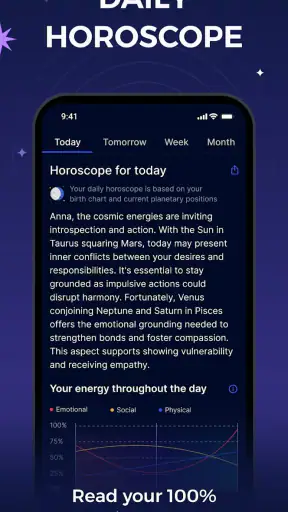
The first thing I noticed is that the app is organized around several different ways of engaging with astrology. A daily horoscope is the quickest entry point, while a birth chart invites a slower look at personality and life themes. Tarot adds a more prompt-based, reflective activity, and compatibility gives the app a social angle. The moon calendar rounds this out with a time-oriented view that can become part of a personal planning habit.
This combination matters because these tools serve different moods. On a busy morning, I might only want a short horoscope to set an intention for the day. On a quiet evening, I may be more interested in examining a birth chart or drawing meaning from a tarot reading. The app is therefore less like a single-purpose horoscope feed and more like a small collection of astrology activities sharing the same home.
I would not use every section with the same level of seriousness. The daily material is best treated as a prompt for self-reflection, not as a reason to make an important financial, medical, or relationship decision. Compatibility can be entertaining when two people compare signs, but it should not replace an honest conversation. The moon calendar may appeal to people who already enjoy lunar cycles, although users who want a straightforward calendar with practical scheduling tools will probably prefer a conventional calendar app.
A useful routine for first-time users
If I were recommending Astro to a friend, I would suggest starting slowly rather than opening every section at once. Begin with the daily horoscope for several days, then look at the birth chart when you have enough time to read it thoughtfully. After that, try the compatibility feature with a friend or partner as a conversation starter, not as a verdict. This sequence makes it easier to see which parts genuinely interest you and which ones feel decorative.
One particularly useful habit is to write down what a reading makes you notice before checking it again later. For example, if a daily entry encourages patience, I can use that as a reminder during a difficult workday and then decide at night whether it changed my behavior. That turns passive scrolling into a small journaling exercise. The app does not need to be “right” in a literal sense for this workflow to be valuable.
Another practical tip is to separate entertainment from personal guidance. I would avoid opening a tarot reading immediately before making a major decision, because the wording can influence how I interpret events. Instead, I find the feature more useful when I use it to generate questions: What am I avoiding? What information do I need? Which assumption should I challenge? That approach gives the app a clear role without handing it authority it cannot reasonably have.
Birth charts are the deeper part of the experience
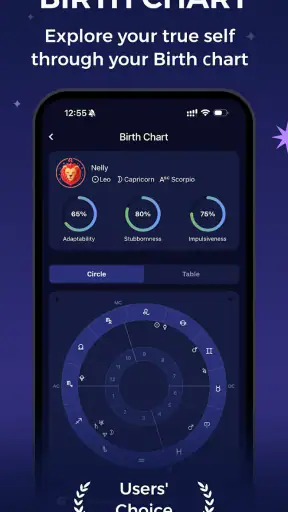
The birth chart is likely to be the feature that keeps more committed users returning. Unlike a quick daily message, it encourages users to explore a broader astrological profile. The trade-off is that a birth chart can feel overwhelming if you are new to signs, planets, houses, and related terminology. I would have preferred a learning path that gradually explains each element instead of assuming that every reader already knows how to interpret a chart.
For a newcomer, the best way to use this section is to focus on one theme at a time. Start with personality or communication, then move to relationships or motivation. Reading everything in one sitting can make the information blur together, while revisiting a single point during the week gives it more context. This is one of the app’s less obvious strengths: it can support a personal reflection routine if you resist the temptation to consume every interpretation immediately.
There is also an important accuracy expectation to manage. Birth-chart interpretations depend on the details a user enters and on the interpretive system behind them. I would double-check personal information before treating the result as meaningful, and I would remember that a polished explanation can still be broad enough to fit many people. The app presents an engaging interpretive experience, but it should not be confused with a validated personality assessment.
Tarot and compatibility work best as social features
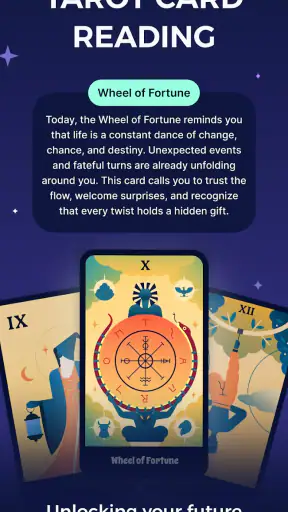
The tarot section adds variety, especially for users who enjoy prompts with a symbolic or spiritual tone. I see it as most effective when used privately or shared casually with someone who understands that it is interpretive. A useful approach is to ask a focused question and compare the reading with your own first reaction. If the result makes you uncomfortable, that is a reason to reflect on the concern it exposed, not an instruction to act.
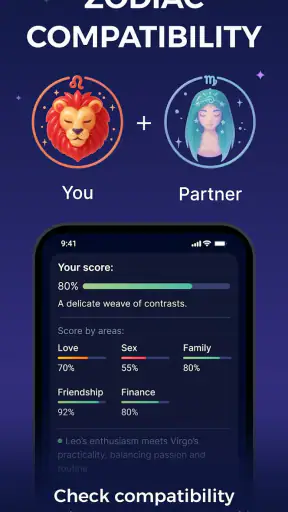
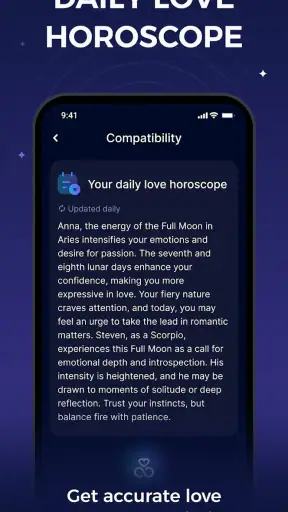
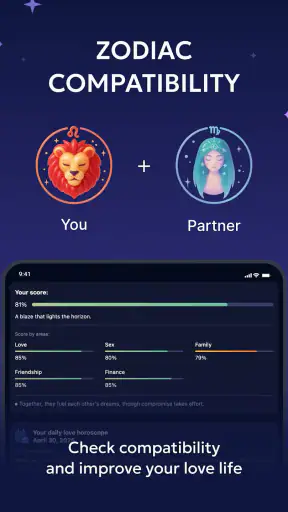
Compatibility is similarly better as a starting point than a conclusion. It can make a light conversation more interesting, particularly when two people compare how they see themselves. However, reducing a relationship to zodiac combinations can become limiting. Communication style, trust, values, and circumstances matter far more than a compatibility score or description. Users who want detailed relationship coaching should look elsewhere; users who want a playful way to discuss differences may enjoy this section.
These features also reveal a broader trade-off in the app’s design. Astro offers breadth, but breadth means that no single tool necessarily feels as specialized as a dedicated tarot, chart, or relationship service. I consider that a fair compromise for someone who wants everything together. If one area is your only interest, a focused alternative may provide a more detailed experience and a clearer learning structure.
The moon calendar gives the app a planning angle
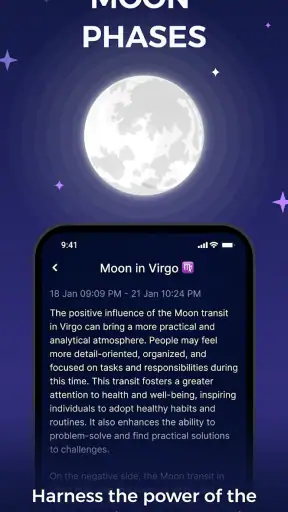
The moon calendar is the feature that can make the app feel less like a collection of readings and more like something I check repeatedly. I can use it as a visual cue for observing lunar phases, planning a quiet evening, or keeping a personal note about energy and mood. It does not need to control my schedule to be useful; it can simply add a recurring rhythm to it.
A realistic example would be a user who feels scattered during a demanding week. They might check the calendar in the morning, choose one small intention for the day, and record how their focus changes by the evening. Over time, the value comes from noticing patterns in their own behavior rather than proving that the moon caused a particular outcome. That is a more grounded use than treating the calendar as a guarantee of good or bad timing.
Still, this section will not satisfy someone searching for professional astronomical information. The app belongs to the lifestyle and astrology space, not to scientific observation. If you want exact sky tracking, telescope guidance, or an astronomy reference, a dedicated astronomy app is the better choice.
What the current version means for users
The current version is 6.12.1, which shows that the app has continued well beyond its original release on June 1, 2017. I see that long-running development as a positive sign for people who dislike installing an abandoned app, although a version number by itself does not tell me whether every section has evolved equally. The important point is that Astro is an established product rather than a new experiment with an untested concept.
For existing users, a mature version can make the app feel more dependable as a daily habit. It also means that returning users may notice changes in layout, navigation, or the balance between free and paid material over time. I would not assume that an older routine will remain identical forever. If a favorite reading or section becomes harder to reach, taking a moment to explore the current navigation is worthwhile before deciding that it has disappeared.
The app remains free to download, which lowers the barrier to trying the core experience. Optional in-app purchases range from $1.99 to $49.99 per item, so I would pay attention to what is available without spending and avoid purchasing simply because a reading feels emotionally persuasive. The upper end of that range makes it especially important to check the purchase screen carefully and decide in advance what, if anything, you are comfortable paying for.
Where the experience still has friction
The biggest limitation is the gap between a broad feature set and the depth a specialist may expect. Someone who wants a rigorous natal-chart study may find the explanations too accessible or generalized. Someone interested only in tarot may feel that the surrounding horoscope and moon content adds clutter. The app’s all-in-one approach is convenient, but convenience is not the same as specialization.
I also think users should be prepared for repetition. Astrology content often relies on familiar themes such as patience, communication, confidence, and emotional balance. When the wording feels personally relevant, that repetition can be comforting; when it does not, it can make the experience feel generic. My advice is to judge the app by whether it helps you think clearly or build a useful routine, not by whether every sentence sounds uniquely written for you.
There is a second kind of friction around expectations. A daily horoscope is easy to consume, but it can encourage checking without reflection. If I open the app repeatedly just to seek reassurance, it stops being a helpful lifestyle tool and starts becoming a source of indecision. Setting a limit, such as one reading in the morning and one review at night, keeps the experience more balanced.
Privacy-conscious users should also take a thoughtful approach to personal details. Astrology tools naturally ask for information relevant to chart calculations, and users should consider what they are comfortable entering into any service. I would avoid sharing unnecessary personal information and would review the app’s current prompts before creating a detailed profile. That is sensible practice for any lifestyle app, especially one that encourages intimate reflection.
Who should try it, and who should skip it
I think Astro is a good fit for curious beginners, casual horoscope readers, and people who enjoy combining short daily prompts with broader birth-chart exploration. It also suits friends or couples who want a playful compatibility topic, and users who like moon-phase rituals without needing an advanced astronomy tool. The Everyone age rating makes it approachable for a wide audience, although younger users should still understand that the readings are entertainment and reflection, not professional advice.
I would skip it if you want scientific explanations, exact astronomical data, or a purely practical calendar. I would also look for another option if you need a highly technical chart analysis, structured therapy exercises, or dependable decision support. The app can complement journaling and self-observation, but it cannot replace a qualified professional when the subject involves health, money, safety, or serious emotional distress.
Compared with checking a horoscope on a general website, Astro feels more cohesive because the chart, tarot, compatibility, and lunar material sit within one experience. Compared with a dedicated astrology service, it may feel less focused but more convenient. That is the central decision: choose this app for variety and accessibility, not because it promises the deepest possible treatment of one branch of astrology.
What I would watch as the app continues
For future use, I would pay attention to how Talentin balances the free experience with optional purchases. The app is easiest to recommend when a new user can understand its value before encountering purchase prompts. Clear separation between freely available material and paid extras would help users make calm decisions, particularly when they are reading emotionally charged content.
I would also watch whether the birth-chart explanations become easier for beginners to learn from. The app already brings several concepts together, but better guidance could turn its breadth into a genuine advantage instead of making new users jump between interpretations. Small improvements in navigation and explanation would matter more to me than simply adding another content category.
Finally, I would like to see the lifestyle side remain grounded. The strongest version of this app is one that encourages observation, journaling, and thoughtful conversations rather than certainty about the future. If it keeps that balance while maintaining the convenience of its current toolset, it can remain a pleasant daily companion for astrology enthusiasts.
My overall view is positive but measured. Astro is a polished starting point for exploring daily horoscopes, birth charts, tarot, zodiac compatibility, and the moon calendar in one place. I would recommend trying the free experience first, using the readings as prompts, and deciding only afterward whether any optional purchase adds real value. Its best use is not predicting your life, but giving you a simple structure for thinking about it.


